
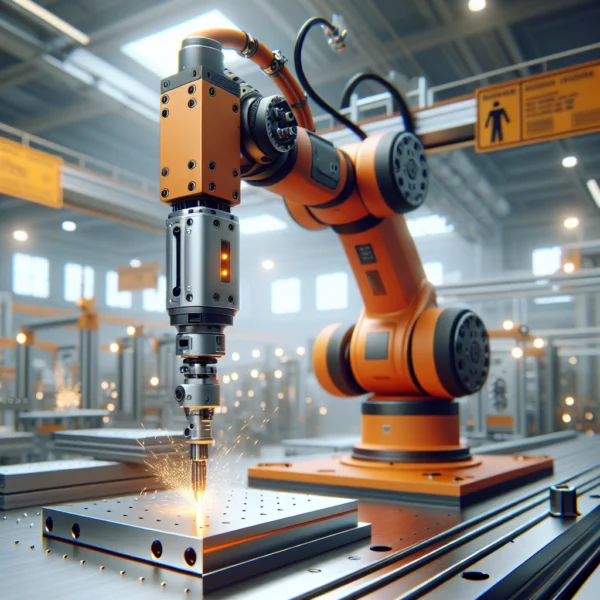
Collaborative Robots Retrofitting Hand Tools: A Technical Deep Dive
The manufacturing landscape is constantly evolving. Businesses seek increased efficiency and reduced costs. Collaborative robots (cobots) are playing a larger role. One interesting application is retrofitting existing hand tools. This article explores this trend, offering practical advice for implementation.
The Challenge: Improving Efficiency with Existing Assets
Many factories rely on established hand tools. These tools are often perfectly functional. However, manual operation can be slow and inconsistent. It can also contribute to repetitive strain injuries. Replacing all existing tools is often cost-prohibitive. A better approach is retrofitting these tools for cobot integration.
The core problem lies in automating tasks performed with hand tools. How can we achieve robotic precision and consistency? How can we maintain operator safety? How do we minimize downtime and capital expenditure?
Understanding the Benefits
Retrofitting offers several advantages. It preserves existing investments in hand tools. It reduces the need for entirely new robotic systems. This lowers initial costs. Furthermore, retrofitting allows for a phased implementation. This allows businesses to gradually integrate automation.
The Technical Solution: Cobots and Retrofitting Kits
The key is integrating cobots with custom or off-the-shelf retrofitting kits. These kits often include mounting brackets and control interfaces. They allow cobots to manipulate hand tools with precision. Force sensors and vision systems are often added.
Cobots are designed to work safely alongside humans. They have built-in safety features. These features include force limiting and collision detection. These features ensure safe operation in collaborative environments. You can learn more about cobot safety standards from OSHA: OSHA Website.
Components of a Retrofitted System
A typical retrofitted system consists of several elements. These include a cobot, a hand tool, and a retrofitting kit. The retrofitting kit provides the mechanical interface. It also often includes sensors and a control system. Software is used to program the cobot’s movements and interactions with the tool.
Force sensors are crucial for tasks requiring precise pressure. These sensors provide feedback to the cobot controller. This enables the cobot to apply the correct force. This prevents damage to the workpiece or the tool. Vision systems can also assist in alignment and inspection.
Types of Hand Tools Suitable for Retrofitting
Many hand tools can be retrofitted for cobot use. Examples include screwdrivers, drills, wrenches, and riveters. Grinders, polishers, and even some types of cutters can also be adapted. The feasibility depends on the tool’s design and the task’s complexity.
Implementation Advice: A Step-by-Step Guide
Implementing a cobot retrofit requires careful planning. It also requires execution. A well-defined process ensures success. It also minimizes disruption to production.
Step 1: Task Analysis and Selection
Begin by identifying suitable tasks. Look for repetitive tasks. These tasks are often prone to human error. They may also cause strain injuries. Evaluate the feasibility of automating these tasks with a cobot and retrofitted hand tool. Consider factors like tool weight, access, and required precision.
Step 2: Tool and Cobot Selection
Choose a cobot that meets the application’s requirements. Consider its payload capacity, reach, and speed. Select a retrofitting kit compatible with both the cobot and the hand tool. Ensure the kit provides the necessary mounting and control interfaces. Consider using a cobot size guide for selecting the right one: Universal Robots Cobot Selector.
Step 3: Retrofitting Kit Integration
Carefully install the retrofitting kit on the hand tool. Ensure secure mounting and proper alignment. Connect any sensors and actuators to the cobot controller. Calibrate the system to ensure accurate positioning and force control.
Step 4: Cobot Programming
Develop a cobot program to control the tool. Use the cobot’s programming interface. Define the desired movements and forces. Incorporate sensor feedback to adjust the program in real time. Test the program thoroughly in a simulated environment. This helps ensure safety and functionality.
Step 5: Safety Considerations
Implement robust safety measures. These measures are essential to protect workers. Conduct a risk assessment to identify potential hazards. Implement safety features like light curtains and emergency stops. Train personnel on cobot operation and safety protocols. Always prioritize safety over speed.
Step 6: Testing and Optimization
Test the retrofitted system in a real-world production environment. Monitor its performance and identify areas for improvement. Fine-tune the cobot program and adjust sensor settings to optimize efficiency and accuracy. Document all changes and updates.
Case Studies and Examples
While specific real-world data is unavailable, consider hypothetical examples. Imagine a scenario where a cobot is used to tighten screws on electronic assemblies. The retrofitted screwdriver incorporates a torque sensor. This ensures each screw is tightened to the correct specification. This reduces errors and improves product quality.
Another example involves a cobot using a retrofitted grinder to deburr metal parts. The cobot precisely controls the grinder’s path and force. This creates a uniform finish and reduces operator fatigue. A vision system could inspect the parts to ensure quality.
Future Trends
The trend of retrofitting hand tools with cobots is likely to continue. Advancements in sensor technology and artificial intelligence will further enhance the capabilities of these systems. Machine learning algorithms can optimize cobot movements and force control. This enables more complex and delicate tasks. The incorporation of IoT devices will allow for remote monitoring and predictive maintenance.
Cloud-based platforms will facilitate data sharing and collaboration among manufacturers. This will help to standardize best practices and accelerate the adoption of cobot retrofitting. New materials and manufacturing techniques will also lead to lighter and more durable retrofitting kits. Keep an eye on robotics industry trends at the Robotics Industries Association: Robotics.org.
Conclusion: A Path to Efficient Automation
Retrofitting hand tools with collaborative robots offers a compelling solution. It bridges the gap between manual labor and full automation. It is a cost-effective approach. It allows manufacturers to improve efficiency, reduce costs, and enhance worker safety. By carefully planning and executing the integration process, companies can unlock the full potential of this technology. Embrace the future of manufacturing with cobot-assisted hand tools.
As technology advances, expect even more sophisticated and user-friendly solutions to emerge. The key is to stay informed, adapt to new developments, and prioritize safety and collaboration. This ensures that automation enhances, rather than replaces, human skills and expertise. Consider reading white papers about industrial automation: Automation.com.
🛠️ $5,000 Tool for your Cobot?
Why overspend? Turn hand tools you already own into precision cobot tools.
Our universal adapters let you mount standard grinders, sanders, and drills to your collaborative robot in minutes.
Leave a Reply