
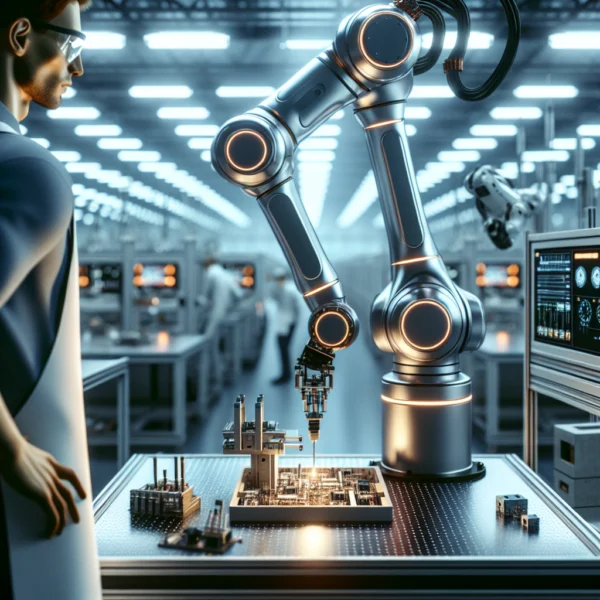
Universal Robots & Techman Robot Market Trends: A Technical Overview
The manufacturing landscape is changing rapidly. Automation is now a necessity. Collaborative robots, or cobots, are at the forefront. Two key players are Universal Robots (UR) and Techman Robot (TM). This article explores their current market trends.
The Growing Need for Flexible Automation
Manufacturers face increasing pressure. They need to boost efficiency. They also need to reduce costs. Skilled labor shortages are a major problem. Cobots offer a solution to these challenges. They provide flexible automation options. They can work safely alongside humans. This makes them suitable for various tasks.
Traditional industrial robots are often expensive. They require significant safety infrastructure. Cobots are more affordable. They are also easier to program and deploy. This accessibility drives market growth.
Trend 1: Increased Adoption in SMEs
Small and medium-sized enterprises (SMEs) are adopting cobots. They are finding them easier to integrate than traditional robots. UR and TM robots offer user-friendly interfaces. They also provide extensive training materials. This simplifies programming and setup.
SMEs often have limited technical expertise. Cobots’ ease of use makes them an attractive option. They can automate specific tasks without requiring a full-scale automation overhaul. This phased approach minimizes disruption.
Technical Solutions Driving SME Adoption
Several technical features enable SME adoption. These include intuitive programming interfaces. Drag-and-drop programming is common. Built-in safety features are also crucial. Force sensors and collision detection are standard. These prevent accidents when working near humans. Lightweight designs make cobots easy to move. They can be redeployed for different tasks as needed.
Moreover, the availability of end-of-arm tooling (EOAT) solutions is expanding. This allows SMEs to quickly adapt cobots for specific applications. Examples include grippers, vision systems, and welding torches.
Consider UR’s ecosystem of UR+ certified products: Universal Robots UR+. This provides pre-tested and validated EOAT solutions. This reduces integration time and risks.
Trend 2: Focus on User-Friendly Programming
Ease of programming is a key differentiator. Both UR and TM prioritize user-friendliness. They offer graphical programming interfaces. These require minimal coding experience. This empowers non-technical personnel to operate and maintain the robots.
Technical Advantages of Simplified Programming
Graphical programming reduces the learning curve. Operators can use drag-and-drop interfaces. They can also use teach pendants to guide the robot. Offline programming tools allow simulation. This helps optimize robot paths before deployment. The robots’ built-in force/torque sensors make programming complex tasks easier.
TM robots often include a built-in vision system. This simplifies programming for vision-guided tasks. Consider the TMflow interface from Techman: Techman Robot Software. This interface enhances the simplicity of programming.
Trend 3: Expansion into New Applications
Cobots are expanding beyond traditional manufacturing. They are entering new sectors such as healthcare, logistics, and agriculture. UR and TM robots are adapting to these diverse applications. They are incorporating advanced sensing and manipulation capabilities.
Technical Adaptations for Diverse Applications
In healthcare, cobots assist with tasks like dispensing medication and assisting in surgery. In logistics, they are used for picking, packing, and sorting. In agriculture, they can perform tasks like harvesting crops and pruning plants. These applications require specialized EOAT. They also require advanced control algorithms.
Consider the use of cobots in collaborative welding: Collaborative Welding Robots. This requires precise motion control and advanced welding techniques.
Trend 4: Integration with Industry 4.0 Technologies
Cobots are increasingly integrated with Industry 4.0 technologies. These include the Internet of Things (IoT), cloud computing, and artificial intelligence (AI). This integration enables real-time monitoring. It also enables data-driven decision-making. Predictive maintenance becomes possible. This reduces downtime and improves efficiency.
Technical Aspects of Industry 4.0 Integration
Cobots generate vast amounts of data. This data can be used to optimize robot performance. It can also be used to identify potential problems. IoT sensors collect data from the robot and its environment. This data is transmitted to the cloud. AI algorithms analyze the data to provide insights and recommendations.
This integration requires secure and reliable communication protocols. Open Platform Communications Unified Architecture (OPC UA) is often used for data exchange. This ensures interoperability between different systems.
Trend 5: Enhanced Safety Features and Collaboration
Safety remains paramount. UR and TM are constantly improving their safety features. They are incorporating advanced sensors and control algorithms. These ensure safe human-robot collaboration. The use of force limiting technology is also essential.
Technical Innovations in Cobot Safety
Force sensors detect collisions between the robot and humans. They automatically stop the robot. Safety-rated monitored stop (SMS) allows robots to operate at higher speeds. They instantly stop when a human enters the workspace. Vision systems can detect human presence. They can adjust the robot’s path to avoid collisions.
Risk assessments are crucial for any cobot deployment. These assessments identify potential hazards. They also implement appropriate safety measures. ISO/TS 15066 provides guidelines for collaborative robot safety.
Implementation Advice for UR and TM Robots
Successful cobot implementation requires careful planning. You must consider your specific needs. Start with a pilot project. This allows you to evaluate the cobot’s performance. It also allows you to identify potential challenges.
Choose the right cobot for your application. Consider the robot’s payload capacity. Also consider its reach and accuracy. Select appropriate EOAT. Train your employees on cobot operation and safety.
Conclusion
Universal Robots and Techman Robot are leading the cobot revolution. Their user-friendly interfaces are driving adoption. They are also expanding into new applications. They are integrating with Industry 4.0 technologies. Enhanced safety features enable safe human-robot collaboration. By understanding these trends, manufacturers can leverage cobots. They can improve efficiency. They can also boost productivity. They can remain competitive in today’s dynamic market.
🛠️ $5,000 Tool for your Cobot?
Why overspend? Turn hand tools you already own into precision cobot tools.
Our universal adapters let you mount standard grinders, sanders, and drills to your collaborative robot in minutes.
Leave a Reply